
The world seems to have gone mad. To understand what is happening, we need to analyse a very broad historical arc, starting around 2,800 years ago. The study of history and forms of politics reveals fundamental elements of understanding, highlighting the urgent need to change the way politics is organised today, in Italy and around the world.
By “forms of politics” we mean the set of laws, rules and customs that a society adopts to organise its way of doing politics: the study of the forms of politics was carried out by the Italian philosopher Giuseppe Polistena who, after 35 years of independent research, published it in the book “Politica, questa sconosciuta” (Politics, this unknown) (Mimesis Edizioni 2022).
We apologise in advance for some drastic simplifications, which are necessary in order to explain the fundamental concepts.
The Greeks and then the Romans (as early as 500 BC, 2500 years ago) understood that the profound meaning of politics is to confine power and allow those with different visions and interests to reach agreement through discussion, without resorting to violence. They recognised that politics, in its deepest nature, is dialogue between peoples and the negation of war.
With the expulsion of the last king, Tarquinius Superbus (509 BC), Rome entered the Republican period: the government of society was entrusted to two consuls, endowed with great power but only for one year (temporary power), and obliged to decide collegially, so as to control each other.
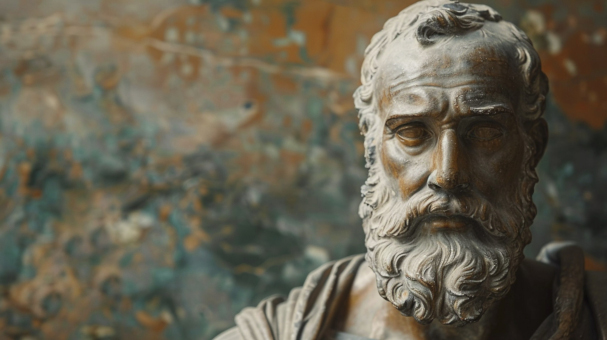
The great philosopher Aristotle (384–323 BC) summarised the prejudices of his time (patriarchy, the inferiority of women, slavery, etc.) in his writings and understood the fundamental importance of politics. However, he stated that politics is a natural characteristic of “well-made” man (man is a “political animal”) and that its purpose is “to do good”.
This last statement represents a terrible intellectual trap, because it strips politics of its intrinsic value as a tool for decision-making without resorting to violence and shifts it to the ethical plane. At the very moment Aristotle recognised politics theoretically, he ended up destroying it.
Some time later, in 27 BC, Rome entered its imperial phase. The political innovations of the Greeks and Romans, not having been codified, were lost, while Aristotle’s thought was handed down to the modern era thanks to Latin translations made in the Middle Ages from Greek and, above all, Arabic texts.
St Thomas Aquinas (1224–1275), one of the theological pillars of the Catholic Church, permeated the Christian world with Aristotelian thought, which thus became the “philosophical” basis on which modern states founded their ways of doing politics.
Because of this “terrible joke” of history, today’s political culture is still deeply imbued with Aristotelian prejudices, which continue to operate and regulate almost all states in the world. Paradoxically, “Western” politics, formally based on ethics (“politics must do good”), is today producing tragic results: the death of hundreds of thousands of people in wars, such as in Gaza; inhuman disparities in the distribution of global wealth; hunger; the inability to address and resolve systemic crises such as climate change in a timely manner. Why is this happening?
It is happening because Aristotelian thinking has led the West to organise politics in an extremely weak way. Over time, politics has been unable to govern human development in a harmonious manner, thus allowing the uncontrolled growth of emerging powers – economic, financial and technological – which have ended up subjugating it.
This has created a self-perpetuating vicious circle which has led, among other things, to an abnormal concentration of wealth and power in a few hands. Suffice it to say, for example, that progressive tax rates in the United States have been drastically reduced since 1950 (see: https://it.wikipedia.org/wiki/Income_tax_(Stati_Uniti_d%27America)).
It is essential to clarify that politics is the only human activity capable of regulating society: neither economics nor finance can do so.
When politics is in a pathological state, the whole system falls into chaos.
Western culture has thus come to conceive and accept, without understanding its gravity, pathological forms of politics that make it structurally weak. We will mention just two:
- the fact that the profession of politician is considered a job like any other and can therefore become a permanent source of income for the livelihood of a person and their family;
- the fact that the same person can be part of the leadership of their party and, at the same time, sit in Parliament to legislate for everyone.
These two customs destroy the effectiveness of politics, which becomes an activity of little use to citizens and incapable of governing the complexity of our age.
Politics is weakened because those who derive their income from it will be viscerally attached to the office they hold. A member of Parliament, for example, will be more inclined to satisfy those who guarantee their re-election (party leaders, powers that finance election campaigns) rather than citizens, who in fact have never been able to really influence their election or re-election. Over time, this mechanism generates mistrust among citizens because politicians make promises during election campaigns but do not keep them in Parliament: those elected avoid approving effective measures that could dissatisfy those who support their careers. But there is more.
A) Belonging to the party leadership allows parliamentarians to control the party’s communication and influence institutional procedures. The party thus loses the ability to freely criticise its elected representatives: those who should be evaluated become their own controllers. Gradually, institutions swallow up spaces that should belong to the public, excluding young people, ageing the political class and making it increasingly difficult for new energy and ideas to come from civil society. This leads to growing abstentionism, which is not simply disinterest, but a more or less conscious perception of the futility of politics as it is organised today.
B) The Western system of selecting representatives in legislative institutions is inherently corrupt, because it pushes candidates and parliamentarians into the hands of those who have the power to determine their careers. This also harms those who believe they are “winning”, as institutions end up making decisions that are contrary to the general interest and even to the laws of nature. This results in slowness in combating climate change, perseverance in the construction and possession of nuclear weapons capable of destroying life on the planet, and uncritical acquiescence to digital technology and social networks.
The radically new solution is to create social politicity, i.e. spaces of exclusive competence of the citizenry, so that it can freely produce political acts and provide guidelines for those in institutions who are called upon to legislate for everyone. It is necessary to separate the party from the institutions that have engulfed it and design it in such a way that it is a free association of citizens in which those who coordinate the party cannot stand for election and those who are in parliament cannot have any power in the party. In addition, mandates must be limited in duration, thus recovering the timing of the Romans. LCI wants to give substance to this approach and hopes that other parties will follow suit.
This is no small feat, considering that in Italy there are over 300,000 people who derive their income from politics. Such a radical change, with 2,400 years of history behind it, requires a non-violent approach and a great deal of intelligence and political skill.
Humanity is at a crossroads: either we create a new human civilisation or we disappear from the face of the Earth.
The image was downloaded free of charge from freedepik.com